Friday, August 5, 2011

Fun Times in Granada, pt 2

Vanessa and I took a tour yesterday of a hammock factory in Granada that benefits at-risk youth. The hammocks were almost twice as expensive as in the market - but I bought one anyway. At $25 it still seemed like a bargain, and the money goes directly to a program that helps people who really need it.

Then we spent our last afternoon in Granada hiking Volcan Mombacho, and doing a zipline canopy tour. Canopy tours feel like cheesy gringo sport to me, and aren't really my thing - but everyone else seemed to really enjoy it. And I have to say that the guides were very professional, and made me feel safe, if not at ease. Plus it was pretty cool to be inside (and high above) an organic coffee plantation.

Later, when we got back to Granada and I showed Vanessa my photos from Volcan Mombacho, she noted the military transport truck that we'd taken up the mountain. "Those trucks used to roll through the villages, during the revolution," she said. Evidently they'd round up any male who looked old enough to hold a rifle - people would run through the streets, warning everyone that the transports were coming, and mothers would beg the soldiers not to take their young sons. So eery now, to be a clueless tourist inside those same transports, heading up a mountain to take a snapshot of the view.

Granada hammock factory
"Wonder Woman" Lesley

Sarah and Elliot suited up

We had to keep reminding people that Nik and Adam are not related...


Making Chocolate

There is a Chocolate Museum that recently opened in Granada, where you can take lessons in how to make chocolate. The classes aren't cheap, so I deliberately held out until this week to take one. We learned all about how chocolate grows, how the beans are harvested and roasted, and how the ancient Mayans, Aztecs, and eventually Spanish made hot chocolate. (Little-known fact: liquid cocoa has been around for over a thousand years, but bar chocolate was only invented after industrialization.) We got to make - and drink - all three kinds of cocoa, and to make bar chocolate too, with our own additives. (I chose rum.)


Fun Times in Granada, pt 1


Vanessa and Vanessa (tocayas)

I haven't had much chance to write this past week, since Lesley and Adam and Sarah arrived. We've been having a great time. Elliot and I changed teachers - I am now studying with my "tocaya" Vanessa, and Elliot is studying with Arlen (who doesn't let him get away with speaking English). Every afternoon we've had a different adventure. The first two: kayaking Granada's isletas, and (re)visiting Volcan Masaya.
Adam and Sarah getting into kayaks
A way better way to see the isletas!
Unlike our first week, the past week's weather has been perfect - warm with a light breeze and no rain except at night. Evidently we are enjoying Nicaragua's "Indian summer" - a brief respite from the rain before winter's rainy season fully kicks in. We are also adjusted, I think: to the climate, the language, the culture, the pace of life. This is starting to feel less like an ordeal, and a lot more like vacation.

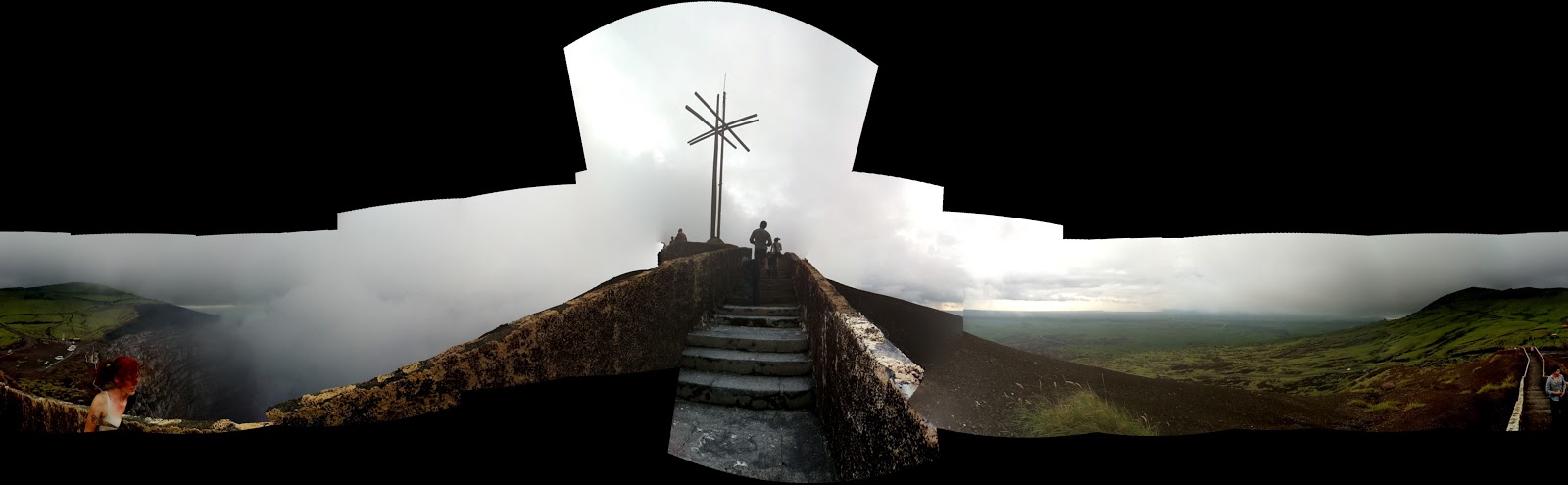
Volcan Mayasa (photo taken with Photosynth) - much more impressive when it's not raining!
Early Spanish explorers placed a cross next to the volcano 'to keep the Devil from leaving the gates of hell'...
Lesley, Adam, and Sarah at Volcan Masaya
Nik and Elliot at Volcan Masaya
 
Sarah and Elliot try whistling with grass at Volcan Masaya

Adios, Granada

Today was our last day in Granada. Somehow, after all this time here, I still hadn't been to the market - so Vanessa took me there to see it. After class we all said some sad goodbye's. It's so hard to say goodbye when I know it's likely I will never see them again! Sarah took her goodbye's particularly hard.

Casa Xalteva - courtyard & kitchen

Casa Xalteva - Main Room


Granada market


Sarah with Gloria and a friend from Casa Xalteva

Monday, August 1, 2011

Genocide, Usury, and the Fountain of Youth


On our last day on Ometepe, we visited Ojo de Agua, a natural (cold) spring pool with restorative properties purported to restore youthful vigor. I'm not sure if I feel younger, but I definitely enjoyed it - the water was beautifully clear and perfectly refreshing, and we were all relaxed when it was time to go.
The road to Moyogalpa
On the way to the ferry, our taxi driver took us to the island's pre-Columbian museum. The price of admission included a guide, which made a huge difference: I've never been able to get too excited by artifacts on display, but with someone there to provide a running commentary and answer questions, it was fascinating. Four different ethnic groups have occupied Ometepe over the last 3000 years, and each one seems to have done a good job obliterating its predecessor. The Spaniards, however, were likely the most thorough and efficient: they enslaved the Nahuatl people, killed off everyone who had traditional knowledge (healers, weavers, potters, etc), and relegated their language to oblivion. (Today the only people in Nicaragua who speak any Nahuatl have learned it in Mexico.) The Nahuatl had writing, and even surgery(!), but almost nothing is left of their vast knowledge: the Spaniards destroyed their scrolls, and no one can read what few scraps are left.


On a smaller but possibly more relevant level of tragedy, our driver told us that gas on Ometepe is $10/gallon, and it's usually so watered down that his little Hyundai sedan (which gets 30 mpg on the mainland) gets only about 17 mpg. Two families control the island's usurious gas distribution system; supposedly they live in luxurious houses and travel a lot.

Elliot on board the ferry

Adios, Ometepe!
At last it was time to leave, and to restart our adventures in Granada - where Lesley and Adam, freshly arrived from Seattle, were awaiting us.

Nights on Ometepe

Our second night on Ometepe, we decided to wander up the road to a hostel called Little Morgans, which was supposed to have a treehouse with a great view. Located about half a mile up the "road" (unpaved), a sign pointed us down another unpaved lane through a beautiful field of flowers and greenery. At the end we followed the sounds of Sting and the Fine Young Cannibals to find a roughly thatched, open-air bar which at first didn't appear to be run by anyone. Eventually we found the manager, who pointed us to the treehouse, and we climbed up to take in the view.

View from the top

Little Morgan's "Treehouse"

After climbing back down, we insinuated ourselves into the bar scene. We ordered the plate of the day (made, I think, by a young expat working for his board), and drank beer with some Australian backpackers, while Elliot played pool with a group of Nica guys. The walk back was a challenge, as we'd forgotten our headlamp, and there were no lights at all in the velvet darkness - but my iPhone cast enough light to guide us over the bumpy terrain and we made it safely home.
Elliot and Linda compare photos

The next night we went in the opposite direction, to join Don and Linda for dinner in Playa Santo Domingo. We'd planned to return on the last bus of the evening - but it didn't show up, so once again we ended up walking home in the dark. (Later we found out that the power had gone out all over the island - leading both to the darkness and, likely, the bus delays.) Luckily, most of the road between Santo Domingo and Casa Istiam is paved.


The darkness was absolute: although we passed the occasional person, dog, and horse - and were passed by the occasional bike (without headlights or taillights) - we could see nothing but the dim cloudy sky above, the silhouettes of trees on either side of the faint ribbon of road before us, and on either side a fantastic sparkle of fireflies that seemed to stretch on to infinity. We could hear a cacophany of night sounds, too: frogs, toads, crickets, and other nocturnal creatures. It was truly magical.

Eventually the bus caught up with us, and we climbed aboard, riding the last 1/4 mile home to Casa Istiam. Riding in the bus' dim yellow light I felt a mixture of relief and sadness at leaving behind the mysterious darkness. The more familiar sounds of bus engine, human exchange and laughter were comforting; but I couldn't help but feel that the darkness and night sounds all around us were important, too - an essential connection to the eart which most of us in the developed world have completely lost touch with.

Thursday, July 28, 2011

Isla de Ometepe, pt 3 (Finca Magdalena)

We explored the road on horseback yesterday. The hotel arranged for a guide, Alberto, to take us up to Finca Magdalena, an organic shade-grown coffee farm. On the finca another guide, Elmer, showed us monkeys, petroglyphs, beehives, coffee plants, and the finca's coffee processing machinery (operational only in summertime, and very rudimentary - most of the work is still done by hand).
Horse bridle made of... electrical extension cord

Finca Magdalena


Nahuatl petroglyphs at Finca Magdalena

Elmer leads us through the finca

It was an amazing experience. But after clop-clopping all the way back to our hotel (a trip that took over an hour each way) I realized that we had completely forgotten to taste the finca's honey and coffee. (Doh!)

Elmer

Alberto
We spent the rest of the day swimming in Lago Nicaragua. At this time of year the water is high, so there is very little beach, and the water is only about three feet deep for dozens of meters out. It made a perfect swimming spot for Elliot, and we were the only people for probably 500 meters in either direction.
Beach across the road from Casa Istiam